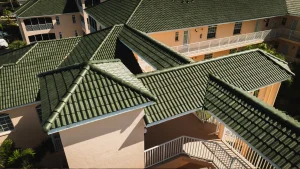

Buying interlocking roof tiles wholesale is very different from purchasing roofing materials for a single house.
For importers, distributors, contractors, and building material wholesalers, the real challenge is not simply finding a low price. A wholesale purchase involves product specifications, minimum order quantities, container loading, packaging, shipping costs, quality consistency, payment terms, and future supply.
A supplier may quote an attractive price per tile, but that number does not necessarily tell you what the product will actually cost after it reaches your warehouse.
This is why buyers sourcing interlocking roof tiles wholesale should evaluate the entire purchasing process rather than comparing supplier quotations line by line.
Whether you are importing one container for market testing or establishing a long-term distribution relationship, the following factors are worth considering.
What Does Wholesale Buying Mean for Interlocking Roof Tiles?
Wholesale roofing purchases generally involve larger quantities than retail or small project orders.
Depending on the product and manufacturer, wholesale orders may be calculated by:
- Pieces
- Square meters
- Bundles or cartons
- Pallets
- Containers
For importers, square meters and container quantities are often more useful than simply looking at the price per individual tile.
This is because interlocking roof tiles can have different dimensions and effective coverage areas.
For example, two tiles may have similar physical dimensions but different overlap requirements. As a result, the number of tiles required to cover one square meter may not be the same.
Therefore, when requesting a wholesale quotation, always confirm:
Price per tile + effective coverage + price per square meter + total container quantity
This gives you a much clearer basis for comparison.
Why Wholesale Price Alone Can Be Misleading
Suppose Supplier A offers an interlocking roof tile at a lower price per piece than Supplier B.
At first glance, Supplier A appears cheaper.
But what if Supplier A’s tile has a smaller effective coverage area?
Or requires more pieces per square meter?
Or has less efficient packaging?
Or cannot provide matching ridge and hip components?
Or requires a larger minimum order?
Or has a longer production lead time?
The initial unit price can quickly become less meaningful.
For B2B buyers, the more useful calculation is:
Landed cost = Product cost + Packaging + Inland freight + Ocean freight + Insurance + Duties + Local delivery
Depending on the trade terms and destination, some of these costs may be included in the supplier’s quotation while others are paid separately.
This is why experienced importers compare the landed cost per square meter, not just the factory price.
1. Decide What Type of Wholesale Buyer You Are
Before contacting manufacturers, determine what type of buyer you are.
Your purchasing strategy will be different depending on whether you are:
A Distributor
A distributor may need regular stock and multiple colors or profiles.
The priority is usually:
- Stable supply
- Repeatable specifications
- Competitive landed cost
- Reasonable MOQ
- Product variety
- Replacement availability
A Roofing Contractor
A contractor may purchase large quantities for specific construction projects.
The main concerns are likely to include:
- Technical specifications
- Project quantity
- Delivery schedule
- Installation requirements
- Accessories
- Consistent quality
A Building Material Wholesaler
A wholesaler may care more about marketability and inventory flexibility.
The questions may include:
- Which profiles sell best?
- What colors should be stocked?
- How much inventory should be held?
- Can different products be mixed in one shipment?
- What is the reorder lead time?
A Project Developer
A developer may be purchasing specifically for a villa, resort, housing development, or other construction project.
In this case, the priority may shift toward:
- Design consistency
- Technical compliance
- Project-wide supply
- Installation support
- Delivery scheduling
- Long-term replacement supply
Identifying your business model first makes it much easier to negotiate the right wholesale arrangement.

2. Understand MOQ Before Asking for a Wholesale Price
MOQ, or minimum order quantity, is one of the first things an importer should clarify.
There is no universal MOQ for interlocking roof tiles.
It can depend on:
- Product type
- Profile
- Color
- Customization
- Packaging
- OEM requirements
- Factory production schedule
A standard product may have a lower MOQ than a customized product.
For example, if you request a special color and private-label packaging, the manufacturer may need to purchase dedicated materials or arrange a separate production run.
That can increase the minimum order.
Should You Always Look for the Lowest MOQ?
Not necessarily.
A low MOQ can be useful when testing a new market, but a manufacturer with a slightly higher MOQ may offer a better overall price or more stable production.
For a distributor, the better question is:
What order quantity gives me the best balance between unit cost and inventory risk?
This is more important than simply finding the smallest possible order.
3. Ask How Many Square Meters Fit in One Container
For imported roofing materials, container loading can have a major effect on your actual cost.
When requesting a wholesale quotation, ask the manufacturer to provide:
- Container type
- Number of tiles per container
- Number of square meters per container
- Total gross weight
- Packaging dimensions
- Number of accessory pieces
- Loading method
Do not assume that every supplier can load the same amount of roofing material into a container.
Tile dimensions, packaging, pallets, cartons, accessories, and loading methods can all affect the final quantity.
For example, a supplier may quote:
1,000 m² per container
while another supplier quotes:
1,200 m² per container.
You cannot determine which supplier is cheaper by comparing the FOB price alone.
You need to calculate:
Total container value ÷ total usable roofing area
That gives you a more meaningful comparison.
4. Compare FOB, CIF, and Other Pricing Terms Carefully
International roofing quotations can use different Incoterms.
Common quotation formats include:
- EXW
- FOB
- CFR
- CIF
The difference matters.
EXW
The buyer takes responsibility for most transportation arrangements from the factory.
This can work for experienced importers with their own logistics network.
FOB
The supplier generally handles the export-side process and delivers the goods to the agreed port according to the applicable FOB terms.
Many international B2B buyers use FOB when they already work with their own freight forwarder.
CIF
The supplier includes ocean freight and insurance to the named destination port.
CIF can make initial budgeting easier, particularly for buyers who do not have established freight arrangements.
However, CIF should not automatically be assumed to be the cheapest option.
For wholesale purchasing, ask suppliers to quote on the same Incoterm and destination basis before comparing prices.
Otherwise, you may accidentally compare completely different cost structures.
5. Calculate the Real Wholesale Cost Per Square Meter
One of the most useful numbers for an importer is the landed cost per square meter.
A simplified calculation looks like this:
Landed cost per m² = Total landed shipment cost ÷ usable roofing area
For example, imagine your total shipment cost is $30,000 and the container contains 1,000 m² of usable roofing material.
Your basic landed cost is:
$30,000 ÷ 1,000 m² = $30/m²
The exact calculation for your business may also need to include customs duties, taxes, local port charges, warehousing, financing costs, and domestic transportation.
This number is much more useful when setting your wholesale selling price.
If you are a distributor, you can then work backward:
Landed cost → Distributor margin → Wholesale selling price → Contractor/retail market price
This allows you to determine whether a particular product is commercially viable before placing a large order.
6. Don’t Forget Roofing Accessories
A common mistake when buying interlocking roof tiles wholesale is focusing entirely on the main tile.
A complete roofing project may also require:
- Ridge components
- Hip components
- Valley components
- Eave components
- Flashing
- Fasteners
- Underlayment
- Ventilation components
- Edge details
The exact accessories depend on the roofing system and project design.
For importers, sourcing compatible accessories from the same manufacturer can simplify procurement.
It also reduces the risk of receiving roofing tiles from one supplier and accessories from another supplier that do not fit properly.
When requesting a wholesale quotation, therefore, ask for a complete accessory price list, not just the main tile price.
ROOFGLORY can work with B2B buyers on complete roofing requirements rather than treating the main tile as an isolated product. This is particularly useful for distributors who need to offer a complete roofing solution to their local customers.
7. Ask Whether Mixed Loading Is Available
Mixed loading can be extremely useful for distributors entering a new market.
Instead of ordering one container containing only one profile and one color, you may want to combine several products.
For example:
- Profile A — 400 m²
- Profile B — 300 m²
- Profile C — 300 m²
The exact possibilities depend on the manufacturer’s MOQ and production requirements.
Mixed loading allows an importer to test multiple products without investing in a large inventory of a single profile.
However, buyers should clarify whether the supplier calculates MOQ separately for each profile or allows several products to be combined toward one container quantity.
This can significantly affect your purchasing strategy.
8. Product Samples Are Important Before Wholesale Orders
Never evaluate a roofing manufacturer solely from website photographs.
Before placing a large wholesale order, request physical samples whenever practical.
The sample allows you to inspect:
- Surface appearance
- Color
- Tile dimensions
- Profile
- Edge quality
- Coating
- Texture
- Interlocking design
- Packaging
For stone-coated products, you can also inspect the granule coverage and overall surface consistency.
If you plan to sell the product under your own brand, the sample can become the reference standard for future production.
This is particularly important for distributors.
Your customers may reorder the same product months or years later, so the manufacturer needs to understand exactly what specification you approved originally.
9. Quality Consistency Matters More Than One Good Sample
A good sample is only the beginning.
The real question is whether the manufacturer can produce thousands of pieces with the same specifications.
For wholesale buyers, quality consistency should cover:
Material → Dimensions → Profile → Coating → Color → Packaging
If one production batch differs significantly from another, it can create problems for distributors.
Imagine a contractor installs 500 m² of roofing using one batch and later adds another 100 m².
If the new batch has a noticeably different appearance, the final roof may look inconsistent.
This is why wholesale buyers should establish a clear product specification before mass production.
At ROOFGLORY, buyers can discuss product specifications, colors, packaging, and other requirements before production so that the approved product is clearly defined.
10. Check Lead Time Before You Promise Delivery to Customers
Wholesale buyers often work on tight project schedules.
A supplier’s lead time therefore matters almost as much as its price.
Ask:
- How many days does production normally take?
- When does production start after deposit?
- How long does packaging take?
- When can the shipment be loaded?
- What happens during peak production periods?
- How are customized orders scheduled?
Do not quote your customer a delivery date based solely on the supplier saying:
“About 20 days.”
Clarify whether that means:
20 days from deposit to factory completion
or:
20 days from production start to loading
These are not necessarily the same.
You should also add realistic ocean transit time, customs clearance, and local delivery when calculating your final customer delivery date.
11. Packaging Is Part of Wholesale Quality
For imported roofing materials, packaging has two jobs:
Protect the product and use shipping space efficiently.
Poor packaging can result in:
- Scratches
- Broken edges
- Deformation
- Surface damage
- Water exposure
- Unstable stacking
But over-packaging can also increase shipping volume and cost.
A professional manufacturer should be able to explain its standard export packaging.
Ask for packaging photographs and, if possible, loading photographs from previous export shipments.
This gives you a better understanding of how your products will actually be prepared for international transportation.
12. Check the Manufacturer’s Ability to Supply Reorders
A wholesale business depends on repeat sales.
Your first container may be successful, but what happens when you need another shipment?
Ask the manufacturer:
- Can the same profile be reproduced?
- Can the same color be maintained?
- How long can the product remain available?
- Can replacement tiles be supplied?
- Can accessories be reordered?
- What is the typical reorder lead time?
This is particularly important if you are building a local distribution brand.
Changing suppliers after every shipment may create problems with product consistency and customer expectations.
A stable manufacturer relationship can make inventory planning much easier.
13. Consider Private Label if You Are Building a Distribution Brand
Once an importer has tested a product successfully, private labeling can become an option.
Instead of selling a generic roofing tile, you may want to sell it under your own brand.
Depending on the manufacturer and order quantity, private-label services may include:
- Custom cartons
- Brand labels
- Product stickers
- Installation manuals
- Customized packaging
- Color cards
- Marketing materials
However, private labeling usually makes the supply chain more complicated.
You should first establish the standard product specification before investing in customized packaging.
For a new distributor, it can be more practical to start with a standard product, test market demand, and then introduce private-label packaging once sales volumes become predictable.
14. Wholesale Buyers Should Compare Suppliers Using the Same Specification
One of the biggest problems in international sourcing is comparing products that are not actually equivalent.
Suppose you receive three quotations:
Supplier A: $4.00/m²
Supplier B: $4.50/m²
Supplier C: $5.00/m²
At first, Supplier A looks like the obvious choice.
But what if:
- Supplier A uses a different base material?
- Supplier B has better packaging?
- Supplier C includes accessories?
- Supplier A has a smaller effective coverage?
- Supplier C has better container utilization?
The comparison becomes meaningless.
Instead, prepare a standardized RFQ.
For example:
| Specification | Requirement |
|---|---|
| Product | Interlocking roof tile |
| Application | Residential/villa |
| Quantity | 10,000 m² |
| Base material | Specified by buyer |
| Thickness | Specified |
| Color | Specified |
| Surface finish | Specified |
| Accessories | Required |
| Packaging | Export packaging |
| Incoterm | FOB |
| Destination | Specified port |
| Inspection | Required |
Then send the same requirements to every manufacturer.
This creates a much fairer comparison.
15. How Much Should You Order?
The right wholesale quantity depends on your business model.
If you are testing a new market, starting with the maximum possible quantity may create unnecessary inventory risk.
If you already have established customers, ordering too little may increase your average freight and purchasing costs.
A practical approach is to estimate:
Expected monthly sales × desired inventory coverage = target inventory
For example, if your expected sales are 500 m² per month and you want three months of inventory, your target stock would be approximately:
500 × 3 = 1,500 m²
You then need to consider the supplier’s MOQ and container capacity.
This helps you determine whether you should order one full container, a mixed container, or negotiate another purchasing arrangement.
16. Don’t Ignore Local Market Preferences
Wholesale success depends on more than factory price.
The product must actually sell in your market.
Before importing a new interlocking roof tile, research:
- Common roof styles
- Popular colors
- Local climate
- Typical villa designs
- Contractor preferences
- Existing competing products
- Local price levels
- Building regulations
- Customer expectations
A product that sells well in one country may not be equally attractive in another.
For example, a particular profile may be popular for villas in one market while another market prefers a more traditional appearance.
Importers should therefore avoid ordering large quantities based solely on what a manufacturer recommends.
Local market data should drive the initial product selection.
17. ROOFGLORY as a Wholesale Roofing Supplier
For importers looking for interlocking roof tiles wholesale from China, ROOFGLORY provides a direct manufacturing option for buyers who need roofing materials for distribution, construction projects, and residential developments.
ROOFGLORY is based in Linyi, Shandong, China, an established manufacturing region for building materials.
Rather than approaching wholesale orders as a simple “price per tile” transaction, ROOFGLORY can work with buyers on the complete purchasing specification.
Depending on the project, discussions can include:
- Product profile
- Tile dimensions
- Material specification
- Color
- Surface finish
- Accessories
- Packaging
- OEM requirements
- Container loading
- Production schedule
- Quality inspection
- Export requirements
This is particularly useful for buyers who want to develop a long-term roofing product line.
For example, a distributor may begin with one container to test market demand, then gradually expand into additional profiles and colors as sales increase.
That approach can reduce inventory risk while allowing the importer to build a more complete roofing range.
18. What Should You Ask a Wholesale Interlocking Roof Tile Supplier?
Before requesting a final quotation, prepare a detailed purchasing checklist.
Product
- What is the exact tile size?
- What is the effective coverage?
- How many pieces are required per square meter?
- What is the weight per square meter?
- What base material is used?
- What coating system is available?
- What colors are available?
Order
- What is the MOQ?
- Can products be mixed in one container?
- Can colors be mixed?
- Are accessories included?
- Can OEM packaging be provided?
Production
- What is the standard lead time?
- What is the monthly production capacity?
- Can the same specification be supplied for future orders?
Quality
- What inspections are performed?
- Can samples be provided?
- Can third-party inspection be arranged?
- How is batch consistency controlled?
Logistics
- How many square meters fit in one container?
- What is the gross weight?
- How are the products packaged?
- Can FOB and CIF quotations both be provided?
The more specific your initial inquiry is, the easier it is for the manufacturer to provide an accurate quotation.
Wholesale vs Retail: Why the Buying Process Is Different
Retail buyers usually focus on:
Product appearance + price + availability
Wholesale buyers need to consider much more:
Product + specification + MOQ + production + packaging + logistics + quality + margin + repeat supply
This is why an importer should not simply search for:
“cheap interlocking roof tiles”
and choose the first supplier offering a low price.
The real objective is to build a supply chain that allows you to sell the product profitably and consistently.
A Simple Formula for Evaluating a Wholesale Supplier
When comparing manufacturers, you can evaluate them across five areas:
Product
Does the product meet your market’s technical and visual requirements?
Price
Is the landed cost competitive after all major logistics expenses?
Production
Can the factory consistently produce your required volume?
Logistics
Can the manufacturer package and load the products efficiently?
Long-Term Supply
Can you reorder the same product when your customers need it?
A supplier that performs well in all five areas may be more valuable than a supplier offering the lowest initial price.
Final Thoughts
Buying interlocking roof tiles wholesale requires a different mindset from buying roofing materials for a single project.
The price per tile is only one part of the calculation.
Importers should evaluate the complete purchasing chain:
Product specification → MOQ → Factory price → Packaging → Container loading → Shipping → Landed cost → Market selling price → Reorder supply
Getting this sequence right can make a significant difference to your margins.
For distributors, the goal is not simply to import one inexpensive container.
The goal is to establish a product and supply chain that can support repeat sales.
That means finding a manufacturer that can maintain consistent specifications, offer practical wholesale quantities, provide reliable packaging and production, and communicate clearly throughout the process.
If you are sourcing interlocking roof tiles wholesale from China, ROOFGLORY can work with you on product selection, specifications, samples, packaging, container loading, and export preparation.
Send your target market, estimated quantity, preferred roof tile style, and destination port to discuss the appropriate product configuration and wholesale quotation.