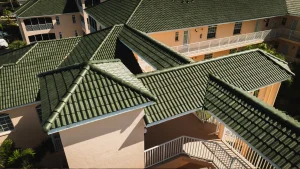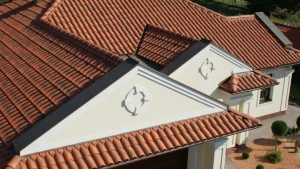

When choosing roofing materials for a villa project, the roof is not simply a finishing material. It affects the building’s appearance, structural requirements, installation process, maintenance costs, and long-term performance.
For builders, developers, architects, and roofing material importers, interlocking roof tiles for villas can be an attractive option because their overlapping design provides a defined installation system while offering a wide range of roof styles. However, choosing the right tile is more complicated than comparing colors or unit prices.
The same interlocking roof tile may perform very differently depending on the roof pitch, climate, supporting structure, installation method, and project requirements.
So, what should builders consider before specifying interlocking roof tiles for a villa?
This article looks at the decision from a construction and procurement perspective rather than simply listing product features.
1. Start With the Villa Design, Not the Roof Tile
The first mistake builders often make is selecting a roof tile before considering the overall villa design.
A Mediterranean villa, modern villa, tropical resort villa, and traditional European-style house may all use interlocking roof tiles, but they usually require different roofing profiles and visual treatments.
For example, a villa with a steep pitched roof may benefit from a more pronounced tile profile, while a modern villa with relatively simple roof geometry may require a cleaner and more uniform appearance.
Roof shape also matters.
A project with multiple valleys, hips, dormers, skylights, and roof intersections requires more cutting and detailing than a simple two-slope roof. In these situations, the tile’s dimensions, installation method, and available accessories become particularly important.
For builders, the better approach is:
Villa design → roof geometry → local climate → technical requirements → tile selection
rather than:
Tile price → product selection → figure out installation later
This becomes especially important when importing roofing materials for an entire development project.
2. Check the Roof Pitch Before Choosing Interlocking Roof Tiles
Roof pitch is one of the most important technical factors.
Interlocking roof tiles are not suitable for every roof angle. Their overlapping structure is designed to manage water as it travels down the roof, but the effectiveness of this system depends partly on the slope.
A roof with an appropriate pitch allows rainwater to drain efficiently. A roof with insufficient slope may require additional waterproofing measures or a different roofing solution.
For villa builders, the roof pitch should therefore be confirmed before placing a large order.
This is particularly important for projects in regions with heavy rainfall.
For example, a villa development in Southeast Asia may face frequent intense rain, while a Mediterranean project may have very different rainfall patterns. The same roof tile specification should not automatically be applied to both projects without checking the complete roofing system.
Questions builders should ask:
- What is the minimum recommended roof pitch?
- Is additional underlayment required?
- How should valleys and roof penetrations be waterproofed?
- Are special details required for low-pitch sections?
- Does the installation method change with roof slope?
These questions are more useful than simply asking how “waterproof” the tile is.

3. Consider the Local Climate
Villa roofing is highly climate-dependent.
A roofing product that works well in a relatively dry region may require different specifications in an area exposed to tropical rain, coastal winds, snow, or large temperature fluctuations.
For builders, climate should be considered at the beginning of material selection.
Heavy Rainfall
In areas with frequent rain, water drainage and roof detailing become major concerns.
The interlocking structure can help create controlled overlaps between adjacent tiles, but the roof should still be designed as a complete water-management system.
Underlayment, flashing, valleys, ridge details, and penetrations are all part of the system.
Strong Wind
For villas located in hurricane, typhoon, or cyclone-prone regions, the fixing method becomes particularly important.
The question is not simply whether the tile is “heavy” or “strong.”
Builders should understand:
- How are tiles mechanically fixed?
- What fixing pattern is recommended?
- What substrate is required?
- What wind-load standard applies to the project?
- Are additional fixings required around roof edges and corners?
Wind pressure is often higher around roof perimeters and corners, so installation details can be just as important as the tile itself.
Coastal Environments
Coastal villas face another challenge: salt-laden air.
If the project is close to the ocean, buyers should pay attention to the material composition, coating system, fasteners, and corrosion resistance.
This is especially relevant when comparing different types of metal interlocking roof tiles.
A low purchase price can become less attractive if the roofing system requires premature replacement because of corrosion.
4. Weight Matters, But It Is Not the Only Structural Consideration
One reason some builders consider interlocking metal roof tiles for villas is their relatively low weight compared with many traditional tile systems.
This can be useful for projects where reducing dead load is important.
However, “lighter” does not automatically mean “better.”
The structural engineer still needs to consider the complete roofing assembly, including:
- Tile weight
- Battens or purlins
- Underlayment
- Insulation
- Fasteners
- Roof framing
- Local wind and snow loads
For villa developers, this distinction is important when comparing metal interlocking tiles with concrete or clay roofing.
A lightweight roof can potentially simplify certain structural requirements, but the actual suitability depends on the building design and local structural code.
Therefore, builders should request the actual weight per square meter of the complete roofing system, rather than relying only on the weight of one individual tile.
5. Tile Size Affects Installation Efficiency
Tile dimensions are another practical consideration that is sometimes overlooked during procurement.
Two products may look similar but have different effective coverage areas.
This affects:
- Number of tiles required
- Cutting waste
- Installation speed
- Packaging volume
- Shipping efficiency
- Labor costs
When importing roofing materials for villa projects, builders should distinguish between overall tile dimensions and effective coverage dimensions.
The overlap between tiles means that the visible or effective area covered by one tile may be smaller than its physical dimensions suggest.
For large projects, this difference can significantly affect material calculations.
Instead of asking a supplier only:
“What is the tile size?”
a more useful question is:
“What is the effective coverage area per tile, and how many tiles are required per square meter?”
This gives the purchasing team information that can actually be used for project costing.

6. Installation Method Should Be Evaluated Before Ordering
A roofing product is only as good as the installation system supporting it.
Interlocking roof tiles may be designed for relatively straightforward installation, but villa roofs often contain complicated areas that require additional work.
Typical details include:
- Ridge lines
- Hips
- Valleys
- Eaves
- Gable edges
- Chimneys
- Skylights
- Roof windows
- Ventilation penetrations
A builder should therefore request installation drawings or technical documentation before confirming a bulk order.
This is particularly important for importers supplying local contractors.
If the imported product has no clear installation documentation, contractors may need to develop their own installation method, increasing the risk of inconsistent results.
For a villa development with hundreds of roofs, a small installation problem can quickly become a large project-management issue.
7. Do Not Ignore Roofing Accessories
One of the most common procurement mistakes is comparing the price of the main roof tile while ignoring the accessories required to complete the roof.
A villa roofing system may require:
- Ridge tiles
- Hip components
- Flashing
- Valley components
- Eave details
- Edge pieces
- Ventilation components
- Underlayment
- Fasteners
- Sealants
- Other installation accessories
The exact components depend on the roofing design and product system.
For a small residential project, sourcing accessories separately may be manageable.
For a large villa development, however, inconsistent accessories can create installation problems and affect the appearance of completed roofs.
This is why B2B buyers should evaluate the complete roofing system, rather than purchasing the main tiles as a standalone commodity.
8. Appearance Is More Important for Villas Than for Many Other Buildings
Villa roofing has a strong architectural function.
The roof can account for a significant portion of the building’s visible exterior, particularly on pitched-roof villas. As a result, the tile profile and surface finish can directly influence the perceived quality of the property.
Builders may need to consider:
- Tile profile
- Color
- Surface texture
- Gloss level
- Edge appearance
- Ridge and hip appearance
- Color consistency between batches
This matters particularly for developers building multiple villas within the same community.
If the roof colors vary noticeably from one batch to another, the finished development can look inconsistent.
For this reason, importers should discuss color standards and batch consistency with the manufacturer before production begins.
For projects using stone-coated metal tiles, it is also worth checking the coating and stone granule specifications rather than selecting colors from photographs alone.
9. Think About Maintenance From the Beginning
The initial purchase price is only one part of villa roofing costs.
Builders and developers should also consider what happens after installation.
A roof may remain in service for decades, so maintenance requirements can influence the property’s long-term operating costs.
Important questions include:
- How often does the roof require inspection?
- Can individual damaged tiles be replaced?
- Are replacement tiles readily available?
- How easy is it to access the roof?
- How does the coating perform over time?
- What happens if the roof is exposed to severe weather?
This is especially relevant for villa resorts and property developments.
For a private villa, replacing a few tiles may be relatively simple.
For a resort containing dozens or hundreds of villas, maintenance becomes an operational issue.
Standardized roofing products and reliable replacement supply can therefore have significant value.
10. Think About Replacement Availability When Importing
For B2B buyers, one issue deserves special attention: future replacement supply.
Imagine a developer imports roofing materials for a 100-villa project.
The project is completed, but five years later several roofs require replacement tiles because of storm damage or accidental breakage.
If the original supplier has discontinued the product or changed the profile, sourcing matching replacement tiles may become difficult.
Therefore, importers should retain product specifications and confirm whether the manufacturer can maintain the same profile and color over the expected project lifecycle.
This is one reason working directly with an established manufacturer can be valuable for long-term development projects.
11. Compare the Total Installed Cost, Not Just the Tile Price
When comparing roofing materials, buyers often focus on the FOB or factory price per square meter.
That number is useful—but incomplete.
The actual cost of a villa roof can be considered as:
Total roofing cost = Material + Accessories + Shipping + Installation + Maintenance + Replacement
A cheaper tile may require more pieces per square meter, more complicated installation, or more accessories.
Conversely, a higher-priced roofing product may reduce installation time or structural requirements.
For importers, a more meaningful comparison is therefore the installed cost per square meter.
This is particularly important when comparing interlocking metal roof tiles with clay, concrete, asphalt shingles, or other roofing systems.
12. Transportation and Packaging Matter for Imported Villa Projects
Roofing materials occupy significant shipping volume, so packaging efficiency can affect landed cost.
For international buyers, the calculation should include:
Factory price + packaging + inland transportation + ocean freight + insurance + customs + local delivery
The physical characteristics of the tiles can influence container utilization.
A manufacturer experienced in export projects should be able to provide packaging dimensions and loading information so the importer can estimate container quantities accurately.
For larger villa developments, it is also useful to divide shipments according to construction phases.
Instead of receiving all roofing materials at once, staged deliveries may reduce on-site storage requirements and lower the risk of damage before installation.

13. Check Manufacturing Consistency
A sample can look excellent while mass production tells a different story.
For B2B villa projects, manufacturing consistency is critical.
Buyers should evaluate whether the manufacturer can maintain consistent:
- Dimensions
- Profile shape
- Coating
- Color
- Surface finish
- Raw material thickness
- Accessories
- Packaging
This is particularly important for developers who need the same roofing appearance across multiple buildings.
Before placing a large order, importers may request production samples, technical specifications, quality inspection procedures, and pre-shipment inspection arrangements.
The goal is not simply to find a tile that looks good.
The goal is to find a product that can be reproduced consistently across the entire project.
14. Ask the Manufacturer for Technical Information
A serious roofing manufacturer should be able to provide more than a product catalog.
For a villa project, buyers may need information such as:
- Product dimensions
- Effective coverage
- Weight per square meter
- Raw material specification
- Coating system
- Recommended roof pitch
- Installation method
- Fastener requirements
- Packaging details
- Loading quantity
- Available colors
- Accessory specifications
Depending on the destination market, buyers may also need documentation related to applicable standards and testing.
This information allows the architect, engineer, contractor, and purchasing team to evaluate the product before committing to a large quantity.
15. Consider Local Building Codes
International villa projects cannot be evaluated using product specifications alone.
The roofing system must comply with the requirements applicable to the destination market.
Depending on the location, this may involve requirements related to:
- Wind resistance
- Fire performance
- Structural loading
- Waterproofing
- Corrosion resistance
- Energy efficiency
- Roofing installation
The manufacturer can provide product information, but the project team remains responsible for confirming local code requirements and determining whether the selected roofing system is appropriate.
For importers, this should be checked before production, not after the container arrives.
16. Interlocking Roof Tiles Can Be a Good Fit for Villa Developments—When the System Is Right
Interlocking roof tiles can offer a practical combination of architectural appearance and installation efficiency for many villa projects.
But the important question is not simply:
“Are interlocking roof tiles good for villas?”
A better question is:
“Are these interlocking roof tiles suitable for this villa project?”
That depends on the roof design, climate, structural requirements, installation system, material specification, accessories, local regulations, and long-term supply.
For B2B buyers, the selection process should therefore move beyond product appearance and unit price.
A reliable roofing specification should answer five basic questions:
Will it work with the roof design?
Will it perform in the local climate?
Can local contractors install it correctly?
Can the manufacturer supply the required quantity consistently?
Can replacement materials be obtained in the future?
If the answer to all five is yes, the product becomes much more than a roofing tile—it becomes a viable component of the villa construction system.
Choosing an Interlocking Roof Tile Manufacturer for Villa Projects
If you are sourcing interlocking roof tiles for villas, working directly with the manufacturer can make the evaluation process easier.
ROOFGLORY manufactures roofing materials in Linyi, Shandong, China, and works with international buyers looking for roofing products for residential and commercial projects.
For a villa development, we recommend discussing the project requirements before requesting a final quotation. Roof pitch, climate, tile profile, required quantity, accessories, packaging, and destination market can all affect the appropriate specification.
You can also explore our metal shake roofing options if your villa project requires a wood-look roof with the appearance of traditional shake roofing and the characteristics of a metal roofing system.
If you are comparing suppliers, send us your roofing area, villa design, destination country, preferred style, and estimated quantity. We can help you evaluate the appropriate tile specification and prepare a quotation based on the actual project requirements rather than simply giving you a generic price per square meter.
Final Thoughts
Selecting interlocking roof tiles for villas is ultimately a project decision, not just a product decision.
Builders need to consider roof pitch, climate, structural requirements, installation details, accessories, appearance, maintenance, transportation, manufacturing consistency, and future replacement supply.
For importers and developers, these factors can have a greater impact on project cost and performance than a small difference in the initial tile price.
The best roofing choice is therefore not necessarily the cheapest tile or the most attractive sample. It is the roofing system that can be specified correctly, supplied consistently, installed efficiently, and maintained throughout the life of the villa project.